Showing posts with label supply chain management. Show all posts

Optimizing value with a win win SCM

http://www.scmr.com/article/optimizing_value_with_a_win_win_supply_chain

Today’s supply chain practitioners are under constant pressure to bring value to their organizations. Two of the biggest supply chain challenges are exponential growth in complexity of the supply chain and cost savings fatigue driven by a relentless and unsustainable pursuit of achieving bottom-line growth by constantly cutting costs.

Companies are responding to these challenges with a renewed approach to their supply chains. A University of Tennessee white paper, “End-to-end Supply Chain Collaboration Best Practices,” shows a highly collaborative end-to-end focus on supply chain, which enables organizations to achieve greater levels of optimization as supply chain partners collaborate to drive continuous improvement and innovations.

But end-to-end optimization is not easy. It demands that supply chain partners shift from traditional transactional business models with the focus on cost savings to models that shift the focus to value creation. To make the shift organizations must first understand the fundamental differences in value extraction, value exchange and value creation.

Value extraction occurs when an enterprise attempts to shift value from one player in the supply chain to itself (classic win-lose scenario), extracting profit and value from one member of the supply chain and transferring that value to a leading player. This is often done using highly competitive bids and power-based negotiations approaches. Value exchange is better, but still falls short. In a fair and balanced value exchange, organizations check their power at the door and instead focus on getting to a fair price versus value tradeoff (such as quality/service). While definitely better than value extraction, value exchange still falls short because the parties’ focus is to optimize within their own four walls.

The winners of today’s supply chains have made the shift to focusing on value creation, enabled by true end-to-end collaboration and win-win pricing models. By working as true partners with a more transparent, win-win mindset, parties can identify opportunities that they simply cannot see by working within their four walls. The longer-term strategic focus, coupled with transparency and a win-win approach, motivates suppliers to invest in solutions they likely would not feel comfortable with.


Strategic Sourcing Best Practices Driving Collaboration


Collaboration is a key to unlocking supply chain optimization. Unfortunately, far too many organizations rely on conventional arms-length procurement methods and commercial models that disincentivize true collaboration and value creation. Traditional buy decisions tend to be based on transactional models, which at its most basic level, rely on a competitive environment to drive lower costs and creates an arms-length buyer-supplier relationship.

Progressive companies are shifting along a sourcing continuum to more sophisticated and collaborative sourcing business models that are purpose built for making the shift to towards value creation as seen in graphic below.


As suggested by the diagram, transactional contracts work best to drive general market improvements. Market-based improvements are typically incremental in nature as suppliers seek to improved products or services and lower prices to beat out their competitors. 

Organizations seeking productivity driven improvements should shift to a preferred provider model or a performance-based/managed services model. When an organization shifts along the sourcing continuum to a preferred provider model or performance-based model they are making a commitment to the supplier who then commits to driving productivity improvements.  Often these productivity improvements come from working in a collaborative manner and investing in continuous improvement programs.
  
As organizations move even further along the sourcing continuum they shift from a mindset of buyer-supplier relationship to one of a highly strategic partner.  A Vested business model and investment-based model encourages investment in innovation because there is equal partnership between buyer and seller.  Structured properly, a Vested model and investment-based models rely on win-win economics where all parties “win” when improvements are made.
  
Win-Win economics makes sense when you think about an equity partnership (e.g., a joint venture) because both parties are investing with the hope to drive value for the partnership. A Vested business operates in a similar manner as an equity partnership –  but unlike an equity partnership a Vested model uses a buyer-supplier relational contract instead of shareholders agreement. 

A Vested model – like investment-based models - works because it creates a win-win outcome-based economic model that aligns the interest of the buyer and supplier partners. In short, the parties shift from a buyer-supplier to one of a mindset of strategic business partners focused on a common end in mind – to drive business outcomes that will create value for both the buyer and the supplier.


Total Value Optimization


A second enabler for success outlined in the UT white paper is a focus on end-to-end total value creation that focuses on breaking through silos and building value from across the supply base, through the four walls of the organization right through to the customer’s customer. 

Maine Pointe’s Total Value Optimization™ (TVO) is a best practice method for value optimization that allows an organization to dynamically anticipate and meet demand by synchronizing its buy-make-move-fulfill supply chain to deliver the greatest value to customers and investors, while still achieving lowest costs to the business.

Senior executives are universally interested in meaningful tools to help communicate where and how opportunities can be realized in their business to achieve high performance and competitive advantage. TVO is an easily communicated maturity scale of how any firm is performing in the critical buy-make-move-fulfill supply chain across the critical dimensions of Procurement, Logistics, Operations, Data Analytics, Leadership and Organization.


Source: Maine Pointe

Using the methods outlined in Total Value Optimization, it becomes more realistic to add a true level of competitive differentiation through the supply chain – ultimately transforming the supply chain into a competitive weapon. The Total Value Optimization approach looks beyond the basic metrics such as cost of ownership and purchase price variance, and adds an increased focus on the total added-value characteristics of the relationship with each supplier.

Total Value Optimization ranks that added value in a maturity scale of zero to five, with the higher levels incorporating that value-added consideration and allowing a firm a more sustainable process that permits themselves as well as their supply chain to continue to grow and improve.


The Bottom Line


The bottom line? It is the bottom line. Creating an end-to-end collaboration culture is never easy, and it takes considerable time and resources. 

Steven Bowen is the Chairman and CEO of Maine Pointe, and the author of Total Value Optimization: Transforming Your Global Supply Chain into a Competitive Weapon. He can be reached at sbowen@MainePointe.com.

Kate Vitasek is recognized for Vested® business model for highly collaborative relationships. She is the author of 6 books and a faculty member at the University of Tennessee. She can be reached at Kate kvitasek@utk.edu 

Orshestrating Supply Chain

https://www.ttnews.com/articles/orchestrating-supply-chain

An increasingly constrained freight market is ratcheting up the pressure on shippers to improve the performance of their supply chains and make better use of the limited hauling capacity of their own private fleets and for-hire carriers.

To further streamline the movement of goods, many companies are adopting various forms of technology to improve shipment tracking and enhance the flow of information.

“We want total supply chain visibility,” said Chris Sultemeier, the former head of supply chain at Walmart Inc. who is working as an industry consultant.

2018 TOP 100 PRIVATE CARRIERS:See the new rankings

When Hurricane Katrina struck the U.S. Gulf Coast in 2005, Sultemeier said he realized how little he knew about the location of goods that would be needed to help the region recover.


Chris Sultemeier

“That resonated loud with me,” Sultemeier said in an interview with Transport Topics. “And it started the ball rolling.”

Later, as the head of Walmart Transportation, Sultemeier remembers meeting with a vendor to discuss an upgrade of the onboard computers used in the company’s fleet of trucks.

“I remember thinking, this isn’t about hardware. It’s about information and connecting things. We can’t be wrapped around a hardware solution,” he said. “In an age of iPhones and open-source applications, what we need is an agnostic device that connects all the components of the truck and gives us the ability to go in and build any application we want that meets our business needs.”

Such a solution didn’t exist then, and still doesn’t, at least in a complete form, although Sultemeier says he sees it “on the horizon.”

Since retiring from his position at Walmart in 2017, Sultemeier has joined forces with Platform Science, a technology firm that is attempting to provide connect­ivity among trucks, stores and distribution centers and is headed by Jack Kennedy, a former president of trucking technology supplier Omnitracs.

“Now we have the ability to do it,” Sultemeier said of the effort to create a digital view of the supply chain for shippers. “What is not yet fully defined is do we go down to the product level or caseload ­level in terms of connectivity. Does Walmart, for instance, want to know where every box of ramen noodles is that sells for 89 cents?”


A walmart employee stocks electric fans. (Timothy Fadek/Bloomberg News)

What’s important, Sultemeier said, is that shippers not be forced to wait for vendors to develop a product that they believe will be in demand in the broader market.

Just tracking cargo on trucks and containers gives most shippers the means to cover 90% to 95% of their supply chains, and that can produce major potential benefits, Sultemeier said.

“Today an overseas shipment runs between 35 and 50 days. If we can reduce that by just one day, we save the cost of carrying that inventory,” he said. “And if we know where stuff is, we can reduce out-of-stock items, which is the Holy Grail for retail.”

With more precise information on the status of shipments and better forecasts of shipping demand, companies have the opportunity to switch to lower-cost modes of transportation.

“If we get better information, the entire supply chain is more efficient,” Sultemeier contends. “Trucks are not sitting and waiting. Drivers are doing more work during their hours-of-service limits.”

Delays at loading docks represent a huge waste of time for drivers and cost shippers billions of dollars in detention fees and higher freight rates, according to Jason Foshaug, a former shipping executive who recently launched a business called VelocityRater.

This company uses data on dwell times to identify sites that have excessive delays in the loading/unloading process and provides benchmarking tools to help both shippers and carriers understand the impact delays are having on their businesses.

“Shippers know how to fix this, they just need to know where to start,” Foshaug said, “but many are simply not aware of the problem or [don’t] understand how this can negatively impact their competitive position in a local market.”


Envisioning the Future of Freight


Readers describe their vision of the future of freight.
 
Technology will continue to drive developments in trucking, from more fuel-efficient equipment to autonomous vehicles. Creative alternatives to offset the continuing driver shortage will be created. Outsourced logistics will continue to grow as private fleets will become more expensive to own and manage.
— Rob Hooper, CEO, Atlantic Logistics
 
Trucking is one of several massive global industries that is evolving rapidly because of new technology. I believe that data collection and network synchronization can bring increased efficiency to trucking and dramatically impact the way that trucking companies operate in the global economy.
— Ozan Baran, founder and CEO, QuickLoad
 
Create the backbone for freight to communicate in real-time environmental conditions, location (indoor and outdoor), security and price through the use of blockchain-connected sensors.
— Orlando Remédios, co-founder and CEO, Sensefinity
 
Tracking of all equipment so customers can see where the truck is and know the [estimated time of arrival]. Customers — both receivers and shippers — knowing the value of the driver’s time and loading quickly. The future driver will be more of a relay driver to ensure they are home with their family.
— Teresa Oswalt, operations manager
 
I think it will go to driverless trucks, but the first- and last-mile industry will be the last and the hardest to complete.
— Jackie Mattare
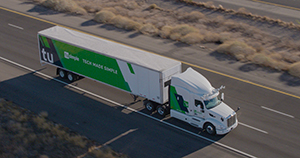
 

An autonomous TuSimple truck drives on a highway. (TuSimple)
 
Freight transport would need to fix the problem of rising freight rates with driver shortages.
Freight movement now has a clear and renewed focus on tracking driver behavior and hours of service. The future would see a dominating need to optimize capacity across all types of vehicles.
Better driver management would help allocate the right trip to the most suited driver well-versed with the route and learned in the type of vehicle assigned.
Automated allocation of shipments to vehicles and drivers would speed up transportation, bringing down lead time and downtime.
Machine learning would be used more and more to design faster and safer routes for trips. This would bring down the turnaround time, in turn bringing down the fuel and maintenance costs.
Live tracking of moving resources would make transport companies agile and responsive.
Companies would be able to track driver behavior such as speeding, unnecessary detention, deviation from planned routes, harsh braking, etc., with instant alerts and notifications passed on to the supervising manager or stakeholder.
Real-time traffic pattern analysis would help predict the best route and accurate ETAs for reaching the in-transit hubs and destination locations.
Fast scanning with in-app or connected scanners would help with fast loading and unloading at hubs, reducing the total time spent there while increasing the transparency with error-free documentation and tracking of each unit transported.
All this would help companies better manage the hours of service of each driver to comply with regulatory and service-level agreements. Instances where a driver’s mandatory break time ends up delaying critical orders would be almost nullified as the driver’s time would be well tracked and managed right from a single dashboard giving end-to-end visibility over all moving and on-ground resources.
Such automation of allocation, routing, tracking and compliance would be the primary need for most companies to run their operations sustainably and profitably.
— Faiz Shaikh, brand content head, LogiNext

Motor carriers typically charge $50 to $100 an hour if drivers are detained beyond two hours. Foshaug estimates that $35 billion is paid out each year in detention charges and in higher freight rates.

Delays also reduce capacity for shippers as carriers increasingly avoid going to locations with slow turnarounds.

“Shippers that turn trucks around in one to two hours are not struggling to get capacity,” Foshaug said.

Foshaug said he successfully dealt with the problem of detention in the past by monitoring metrics daily, pre-staging loads where possible and instituting a special bonus pay program for dockworkers. He also used a clock that began ticking when trucks arrived to provide a visual reminder of the time spent loading and unloading.

In addition, shippers can mitigate delays by ramping up their work forces during high-volume peak periods and by staying open later in the day and on weekends.

Foshaug does not recommend using appointment times to manage the flow of trucks.

“It’s not helpful to carriers,” he said. “Appointments should be set by day or even blocks of time during the day, then first come, first serve, but not a specific time.”

When drivers miss an appointment time, they generally go to the back of the line and that leads to major problems for dispatchers in keeping the drivers on schedule for their next pickups.

At Eaton Steel Bar Co. in Taylor, Mich., company officials have taken steps to make their own facilities and those of their customers more welcoming to drivers. The company is building a new truck maintenance facility in Detroit that will offer food and recreational amenities for drivers while they wait for loads. Also, a new racking system has been installed at some of its facilities to speed up loading and unloading of flatbed trailers.

In addition, the company implemented a detention charge of $100 an hour after the first two hours and raised its rates for customers that create the most delays for drivers.

“We see a lot of changes,” said John Lamarand, operations manager for Atlas Trucking & Logistics, a private fleet for Eaton that operates 125 tractors.

For private fleet managers surveyed by Transport Topics, the most important technologies are those that have an impact on safety and efficiency.

Paul Mugerditchian, president of DOT Transportation, said he is looking for “anything related to safety.” Brad Peppers, fleet manager at Shamrock Foods in Phoenix, seconded the motion, saying he wants “anything safety related.”

The Army & Air Force Exchange Service in Dallas recently took delivery of six new tractors with advanced safety features, including automatic braking and blind spot monitoring, which, according to a company spokesman, already proved to be a factor in helping one of its drivers avoid a crash after his vehicle was cut off in traffic.

“We’ve ordered 20 more,” the spokesman said, adding that the company is looking at deploying real-time tracking, telematics and predictive analytics and event recorders in its fleet.

The use of cameras in the cab and driver coaching were priorities for a number of fleets surveyed, including Air Products in Trexlertown, Pa., and Silver ­Eagle Distributors in San Antonio.

“Right now, it’s driver behavior monitoring, lane departure, collision avoidance,” said Ed Pritchard, senior vice president at Silver ­Eagle Distributors. “In the future, autonomous technology will be taking over out of necessity.”

David Adney, vice president of transportation for Hobby Lobby in Oklahoma City, cited engine diagnostics and “predicting the next breakdown before it happens” as a key area of interest for his firm.

Several fleets cited electronic logging devices and one fleet, Valley Proteins, listed “dynamic dispatching tools” as an important technology for its business.

A few companies, including McLane Co. and The Sherwin-­Williams Co., mentioned autonomous vehicles or electric-­powered vehicles.

Several fleets have announced plans to invest in alternative-fuel trucks.

In May, Anheuser-Busch Cos. in St. Louis placed an order for up to 800 hydrogen-electric powered tractors from Nikola Motor Co. That followed an order in December for 40 Tesla battery-­electric tractors.

Sysco Corp., the nation’s largest food service distributor, placed orders for 50 Tesla Semis in a move that company officials described as the beginning of a process of incorporating alternative-fuel trucks into its fleet.


A Sysco tractor waits at a loading dock. (TT File Photo)

“This reinforces Sysco’s commitment to corporate social re­sponsibility by reducing the environmental impact of our operations,” said Tom Bene, president and chief operating officer. “We will also benefit from reduced fuel and maintenance costs and drive associate enthusiasm with the introduction of new and unique technology.”

For some, the increased focus on monitoring drivers and shipments is a prelude to the event­ual adoption of broad-based data sharing platforms.

Blockchain is one of the technologies that could provide shippers and carriers with a secure network to record data on the movement of goods.

Blockchain is an especially valuable resource for tracking shipments across borders, said Ricardo Costa, chief information officer for Purolator Inc.

The first effects will be seen in the technology and pharmaceutical industries, he said.

“Getting parts and product delivered using blockchain offers all involved parties complete transparency,” Costa explained. “Different factories creating parts for a technology product will be able to trace back any malfunctions or issues using serial numbers and address any problems faster.”

Likewise, blockchain will give food and drugs makers the ability to monitor products from origin to destination, making it easier to identify sources of contamination and eliminate waste.

FedEx Corp., for example, is developing a blockchain application to identify and retrieve unused medications from cancer patients in Memphis, Tenn.

And in Switzerland, the nonprofit Olam Foundation is using blockchain to identify food that is at risk of being thrown away because of spoilage or expiration due to shipping delays.

While blockchain may form the basis for a new collaborative relationship between shippers and carriers, a recent report by KPMG suggests that future supply chains will also need to have the ability to adapt to changing market conditions and new technologies, such as 3D printing, robotics and autonomous vehicles.

“We call this the learning supply chain,” Sam Ganga and Arun Ghosh, principals at KPMG, said in the report. “The fundamental premise is that companies need to change the way they are run by using leading indicators of measurement and performance and managing it as a real-time, event-driven network supplemented by intelligent automation.”


Manufacturing is a business that could be disrupted by 3D printing. (Fast Radius)

One variant of 3D printing even applies to food.

Tyson Foods is investing in companies, such as Memphis Meats, that are replicating animal products in a laboratory. If successful, this process will have implications for companies that transport livestock and meat products.

Manufacturing is another industry that could be disrupted by 3D printing, according to Rick Smith, founder of Fast Radius, a 3D printing company backed by UPS Inc.

Speaking to members of the Truck Trailer Manufacturers Association recently, Smith said manufacturing is ripe for disruption because it is “incredibly inefficient.”

“The entire system has been built on one simple equation, and that is the more things you make, the lower the cost of each. Eventually, you’ll be able to print anything that you can imagine. And costs are not tied to the number of units produced.”

The need for a more responsive supply chain, coupled with capacity constraints and rising freight rates, will force many shippers to adopt technology to streamline operations, including dock scheduling and yard management software, said Dan Clark, president of Kuebix, a firm based in Maynard, Mass., that provides a free multimodal transportation management program.

“Shippers who don’t begin embracing technology will continue to face increasing pressure in the coming months because of the changing supply-chain environment,” Clark said.

The Chinese Millennials - Everything changes, yet in China, it also stays the same

Much has been written about American Millennials and how best to manage and challenge these young people in the workforce.  I work with Millennials at my client’s offices and with student interns at the Reshoring Institute, so I am familiar with how to manage this up and coming group.

But I was surprised by the comments of a factory manager from Dongguan, China when he talked about the new Millennials in the Pearl River Delta cities. This megalopolis of Shenzhen, Dongguan and Guangzhou is commonly known as the “Factory of the World.”  Here, Chinese workers produce most of the electronics, consumer products, apparel and shoes, toys and other things for global consumers.

Consolidation in Health Care

The Affordable Care Act has put pressure on the health care industry to reduce costs and enhance supply chain efficiency by consolidating and streamlining operations. But, as a survey conducted by Cardinal Health highlighted, there are many ways in which achieving this goal has been a challenge.

The research showed that, although the majority of hospital executives feel that better supply chain optimization would lead to more revenue growth and opportunities for cost-savings, just as many agreed their current approaches have been effective. And one function of particular concern is inventory management; 60 percent of executives said issues in this arena lead to them overpaying for transportation and shipping services.

E-Commerce - Supply Chain Technology Consolidation

Software provider E2open is trying to bridge a gap between planning and execution in managing supply chains for retailers with its acquisition of Terra Technology..

The purchase, announced on Friday, brings Austin, Texas-based E2open a technology business focused on forecasting consumer demand, which has become increasingly important as e-commerce has triggered rapid changes in buying patterns and made it harder for retailers to get inventory to the right place.

How Can We Improve the Supply Chain Process?

It is clear to me that there are significant opportunities to improve supply chain efficiencies in our industry.
For those working within, from property to planning to design to construction to asset management, it is apparent that we can do things more effectively and efficiently, both in project delivery and the commercial environment.

By way of example, I recently used my credit card to purchase a train ticket online from SJ (a government-owned passenger train operator in Sweden.) A few minutes after this purchase, I happened to check my bank account on my laptop. I was quite surprised to see that the transaction I had just made on my credit card was already recorded as a future debit, mere moments after I had made the online transaction, and the ticket was immediately texted to my smart phone.

Yet in our built environment industry we are still having substantial, and often significant, delays in communication between components of our supply chain. For example, this is apparent on the asset management side of things, where we often fail to accurately record where and by whom operational or maintenance work has been carried out. Additionally, there is a lack of understanding of asset portfolio costs for transport infrastructure networks or for building and housing stock.

Our industry is progressively improving by comparing ourselves with best practice within the Australian context. However, I often feel we are missing out on significant learning opportunities by not tapping into the experiences of other industries and through international comparisons.

But we must first understand what it is that we are seeking.
Before we can develop the most appropriate skill sets to meet our needs, we first have to understand the requirements that will better integrate property, planning, design, construction and asset management in the supply chain. Which improvements are we seeking and how are we going to measure relative performance in those areas?

In the coming decades, Australia and other countries will be facing challenges as a result of rapid technological progress. It’s fair to say that globally there is a lack of ability to compare like-with-like across specific performance criteria in supply chain improvement. The European Union has also recently called for applied research around construction industry skills to integrate the digital supply chain.

The underlying message here is that we still have a long way to go. Improving our skill sets will allow us to achieve better productivity for the industry and make our industry more intellectually attractive to the next generation.
I would like to share an example I heard recently from Skanska, a world leading project development and construction group. Skanska’s CEO for Finland, Tuomas Särkilahti, recently delivered an impressive presentation at the eighth Nordic Conference on Construction Economics and Organization on Continuous Improvement of Operational Efficiency.

Skanska has a Five Zeros Vision:
Zero loss-making projects
Zero environmental incidents
Zero accidents
Zero ethical breaches
Zero defects

Skanska’s construction analysts are focused on how they can improve productivity, recognising the impact of quality and safety. They track specific performance assessment indicators around safety, customer satisfaction, employee well-being and profitability. They also seek to identify the root cause of any issues. For example, when tracking the Lost Time Accident Rate, they identified that an organisational culture of personal responsibility and caring has a positive impact on lowering the number of workplace incidents and reflects positively on customer satisfaction and profitability.

What I took away from this presentation is that our industry needs to learn how to identify the root cause of issues that prevent us from improving productivity across the supply chain. We need to develop appropriate performance indicators, record and analyse data, and ensure there is follow-up for appropriate corrective action. Knowledge development, learning through partnerships, and measuring and continuous improvement are all part of the construction productivity picture.

I look forward to seeing Australia’s built environment continue its uptake of integrating digital technologies and appropriate performance measurement to improve supply chain efficiencies in our industry.

Contributor:
Keith Hampson

https://sourceable.net/ramping-up-the-supply-chain-process-in-the-built-environment/

Understanding Foreign Supply Chain Risks - What you don’t know can hurt you

Competitive pressures affecting bottom-line profit margins have risen dramatically in today’s global economy. As a result, an increasing number of U.S. companies have turned to outsourcing of goods and services to reduce manufacturing and operational costs.

Although international supply chain outsourcing has long been the arena of large, established international corporations, research suggests that many U.S. companies that fall into the category of small to medium-sized enterprises are also building vast, international supply chains to compete against their larger counterparts.

In many cases, the focus on operational cost saving vs. attention to quality and supply chain compliance has seen more and more companies looking for supplier opportunities in emerging and fast-growing markets. Notably, a PricewaterhouseCoopers survey report released in 2011 indicates that 76 percent of companies dealing with these markets cited corruption as the prime factor of noncompliance.

In addition, in a recently released survey of more than 100 executives compiled by MetricStream, roughly 50 percent of respondents indicated that their organizations had faced an issue of noncompliance resulting from a supplier. On a more encouraging note, the MetricStream survey suggests that about 91 percent of U.S. enterprises have adopted some form of supplier governance and supply chain management process to ensure supplier compliance under the Foreign Corrupt Practices Act. Of concern, however, only 5 percent of the respondents reported that the integration of supply chain risk management systems was in line with their organization’s overall business strategy and corporate governance. The MetricStream survey report concludes, “Most companies approach supplier compliance management with the myopic view of avoiding costly regulatory penalties or lawsuits. In other words, their goal is to protect business value. But what if supplier compliance could actually be used to enhance value?”

Although international supply chain outsourcing has indeed proven to provide potentially significant reductions in operating costs, for those companies less seasoned with the perils of foreign outsourcing, the risk undertaken in doing so could prove devastating. The saying that “what you don’t know can’t hurt you” with regard to foreign outsourcing could never be more wrong.

Ignorance of U.S. and global chain-management regulatory compliance requirements, as well as the risk associated with brand reputation, corporate and risk management governance, legal actions—especially shareholder class-action suites—not to mention faulty or delayed supply of goods and services due to local natural catastrophes or political instability, could lead to the financial ruin of any enterprise.

Furthermore, recent charges made by the Securities Exchange Commission and the Department of Justice based on noncompliance under the Foreign Corrupt Practices Act, and fairly recent additions added to the Frank-Dodd Act, have shifted focus from laying charges against violation by an “enterprise” to the specific responsibilities of the executive directors of the companies involved. This has introduced a new but very potent level of added risk in terms of managing supply chain compliance and corporate governance at the executive level.

Foreign supply chain regulations

Although the Foreign Corrupt Practices Act was introduced in 1977, seemingly little regulatory attention has been given to this foreign anti-corruption legislation until recent years, when the volume of charges made by the Securities Exchange Commission and the Department of Justice against enterprises and their executive directors rose substantially. The PricewaterhouseCoopers report points out that in 2010, the Department of Justice presented 48 prosecutions under the Foreign Corrupt Practices Act compared with two actions taken in 2004. The PricewaterhouseCoopers report also shows a significant shift of attention by the Department of Justice and SEC to take action against an enterprise’s executive directors and even shareholders.

The sudden rise in Foreign Corrupt Practices Act noncompliance charges since 2010 is no coincidence—this increased regulatory attention coincides with the introduction of the Frank-Dodd Act (which was introduced to tighten regulatory requirements and oversight of the financial investment and banking industries following the financial global meltdown of 2008 and 2009). The legislation also contained several seemingly benign provisions such as the Conflict Minerals Rule, initially intended as a form of financial sanctions against the worn-torn Democratic Republic of the Congo and neighboring countries based on violation of human rights.

The Conflict Minerals Rule applies to suppliers of tin, tantalum, tungsten, and gold (3TG). As a result, multiple U.S. enterprises reliant on these raw metals, ranging from sectors such as electronics, communications, aerospace, and automotive manufacturers to jewelry and healthcare, have been severely hampered by this provision of the Frank-Dodd Act. Several lawsuits have subsequently been initiated by business and manufacturing groups against the SEC and Department of Justice to prevent increased application of this rule (as well, or in conjunction with the Foreign Corrupt Practices Act) in pursuing noncompliance prosecutions.

For instance, the Conflict Minerals Rule requires that all enterprises that use off-sourced 3TG minerals, and that fall under the regulation of the Securities Exchange Commission, must submit a compliance report determining on a “reasonable basis” that the base metals procured were not in conflict with the provision. Furthermore, enterprises sourcing these minerals—whether new or recycled and/or considered scrap, must still file a compliance report with the Securities Exchange Commission regardless of the “first source” origin.

An analysis report released by the Securities Exchange Commission subsequent to the introduction of the Conflict Minerals Rule estimates the ruling will affect about 6,000 enterprises in the United States and abroad to the tune of roughly $3 billion in the first year, and at least $200 million each year afterward.

Supply chain governance best practices

It’s clear from recent trends and actions taken by the regulators with regard to oversight of corporate governance and risk management procedures as a whole—whether this involves foreign supply-chain outsourcing or financial arrangements/exposures—that the authorities are attempting to “push and pull” companies into adopting comprehensive and holistic enterprisewide risk management best practices. Unfortunately, this “push-pull” strategy is unlikely to be the best approach in bringing about changes with regard to the corporate mindset. Boards of directors of corporations need to willingly embrace the concept of integrated risk management processes, corporate governance, and enterprisewide best practices with the view that this is not a cost, but an investment in the future. Only the ignorant—or the believers that “what you don’t know can’t hurt you”—will remain focused solely on “cost” vs. the benefit of a comprehensive supply chain risk management system.

About The Author

Sonal Sinha is the associate vice president of industry solutions at MetricStream Inc. , developer of enterprisewide governance, risk, and compliance (GRC) solutions. Sinha is responsible for driving solutions and strategy for MetricStream in consumer packaged goods, retail, and technology industries. She has more than a decade of experience as a risk management, audit, advisory, and compliance leader for consulting and technology companies including Google, Visa and KPMG.

Technology needs to be at heart of the supply chain

With the UK emerging from a recession and companies looking to attract and retain as much business as possible, they need think about how they can streamline their offering without incurring additional costs.

One way they can do this is by tidying up their supply chain. As Marshall Fisher, co-director of the Fishman-Davidson Centre for Service and Operations Management said: “Poor coordination among supply chain partners in the US wastes $30 billion annually.” While Fisher is talking about the US, a lack of co-ordination in the UK could have equally devastating consequences.

If businesses don’t have an efficient supply chain it can quickly translate into excess inventory, stockouts or even a loss of customers. Technology needs to be placed at the heart of the supply chain to make it more efficient.

To do so businesses need to work with the smart logistics companies who can structure their supply chain and have parts and tools sent out through a locker network for engineers to collect at a time and place that suits them. All in all, a locker is a bit of tin. Without the infrastructure and technology to back it up they are pretty much an expensive ornament. Using technology to streamline supply chains can allow businesses to keep stock of all inventory no matter where it is in the country. Having complete visibility in this way can allow businesses to become much more efficient; saving unnecessary journeys being made by engineers to collect parts and having multiple orders consolidated into one delivery. The best logistics companies will have parts delivered to a locker pre-6am and to a collection point no more than three miles from an engineer’s place of work so that they can fit more into their day.

One such business using tech at the heart of its supply chain is Costa Express. Operating self-serve machines in over 1,200 outlets across the UK, Costa Express relies on the ability to get broken coffee machines up and running as quickly as possible so as not to lose revenue. Working with logistics providers, not only can the business keep track of all stock across the country but Costa’s engineers can be sent a text notification when parts are ready for collection, ensuring they don’t have to wait around for a delivery which allows the business to run more efficiently.

Employing tech in the supply chain can hugely relieve the pressures customers place on businesses to deliver. A successful logistics network is all down to the ability to track, trace and route parts in real time, something easily achievable through the use of appropriate supply chain tracking technology. If businesses use them and work with logistics companies, they can be assured their supply chain will operate smoothly while they get down to the nitty gritty of the everyday running of the business, and can have the head space to plan bigger campaigns to keep them ahead of the competition.

Janam Improves Supply Chain Efficiency and Reliability With New Handheld RFID Reader

Janam Technologies LLC, a leading provider of rugged mobile computers that scan barcodes and communicate wirelessly, today announced the launch of its XM2-RFID UHF mobile computer. With best-in-class RFID read range and accuracy, the XM2-RFID UHF is ergonomically designed to deliver business-critical enterprise features to organizations in multiple industries, including retail, transportation and logistics, manufacturing and defense.

The new XM2-RFID UHF fits in the palm of the hand and is optimized to meet the real-world challenges of businesses and government organizations around the world. Weighing only 13 ounces, this high-performance handheld mobile computer reads ISO18000-6C, EPC Global Class 1 Gen 2 tags and is field-proven to complete more than 40,000 tag reads on one battery charge. The XM2-RFID UHF includes Zebra's SE4500 2D imager for robust decoding of the hardest-to-read barcodes—ultimately reducing the complexity and number of devices organizations need to deploy. It also comes equipped with a brilliant 3.2-inch color display and support for Microsoft's Windows Embedded Handheld 6.5 operating system.

"As organizations look for new ways to address today's business challenges, RFID has emerged as a viable and affordable option for applications such as cycle count and inventory management, supply chain efficiency and anti-counterfeiting of luxury goods," said Harry B Lerner, CEO of Janam. "Janam's XM2-RFID UHF is not only fully-featured to meet the needs of a diverse set of mobile workers, but available at a highly attractive price point for organizations focused on improving their bottom line."

The XM2-RFID UHF provides the power and performance needed to cut costs, improve customer service, reduce labor and improve production throughput. It is sealed to IP64 standards and designed for all-day, every-day use in challenging environments.

XM2-RFID UHF Highlights:

Impressively light and fits in the palm of the hand—under 13 ounces
Powerful ARM 9 processor
High-performance barcode scanning
Brilliant 3.2-inch display
Sealed to IP64 standards
128MB/128MB with expansion capability
802.11b/g/n Wi-Fi
Bluetooth
2880mAh hot-swappable Li-ion battery
About Janam
Janam Technologies LLC is a provider of rugged, handheld computing devices for mobile workers.  Janam combines deep industry knowledge with advanced technologies to deliver products and accessories that increase productivity, reduce costs and improve customer satisfaction.  Specializing in purpose-built mobile computers that scan barcodes and communicate wirelessly, Janam offers products that are designed to run mission-critical applications in retail, healthcare, hospitality, manufacturing and logistics.  For more information, visit www.janam.com.

DiCentral and JSOL Partner for Global EDI and Supply Chain Business

DiCentral, a leading innovator in supply chain management solutions and B2B integration, and JSOL, a leading provider of IT solutions tailored to customer needs in every area from IT consulting to system implementation and operation, today announced that the two companies have partnered to deliver DiCentral’s industry-leading EDI and supply chain management solutions to JSOL’s customer base.

“JSOL has many large Japanese NIKKEI 500 enterprise customers and we expect to provide a much higher level of supply chain value via our partnership with DiCentral,” says Yoshio Okada, Platform Solution Division director for JSOL. “DiCentral and JSOL will be collaborating on EDI and supply chain business to help JSOL’s customers in Asia.”

“Japan is an important region for DiCentral when it comes to the supply chain, and it is imperative to have a quality partner to help bring our solutions to the broader Asian market,” says Thuy Mai, founder and CEO for DiCentral. “DiCentral is very excited to have partnered with JSOL to not only meet, but exceed our sales and implementation goals. We look forward to a long and mutually beneficial relationship.”

As the environment surrounding companies becomes more and more complex, the strategic partnership between DiCentral and JSOL will be vital for implementing EDI and supply chain management strategies, ultimately ensuring further growth. JSOL will provide total support, including meticulous consulting for each implementation based on the company’s wealth of knowledge and experience, ensuring low cost and reliability.

About DiCentral

Founded in 2000, today DiCentral is a leading global innovator in EDI (Electronic Data Interchange) software and service solutions. Our broad range of solutions enables a seamless exchange of data throughout the entire supply chain, creating a seamless communication stream from source to last mile. DiCentral's integration solutions are scalable to the size, growth, and unique requirements of each business. In addition, DiCentral develops and markets a complementary suite of supply chain applications for retailers and suppliers, including MFT software, WMS software, POS analytic software, outlier management software, managed EDI services, and more.

About JSOL

The JSOL Corporation is a total IT service provider, offering high-quality IT services to customers in the manufacturing, distribution & services, finance and public utilities sectors. Adding the all-round strength of the NTT Data Group, the JSOL Corporation can offer even more adaptable and specialized solutions to the technological and business know-how accumulated in a wide range of fields since the days when the JSOL Corporation was a division of the Japan Research Institute. The JSOL Corporation has a proven track record in introducing ERP systems and has received successive awards from SAP Japan.